


WOMEN’S HEALTH SERVICES
PELVIC CONGESTION SYNDROME
What is pelvic congestion syndrome?
Pelvic congestion syndrome, or PCS, serves as the primary cause of chronic pelvic pain in women who are in their childbearing years. Pain from PCS could be inconsistent or long-lasting, which happens to prolong between three to six weeks. Pain that radiates within the pelvis or abdominal region, which happens to last throughout the menstrual cycle and without any clear link to pregnancy, is referred to as chronic pelvic pain.
Pelvic congestion syndrome is a vascular-related condition that targets the veins within the pelvic area, but no clear blood drainage output exists.
WHAT ARE THE SIGNS OF PELVIC CONGESTION SYNDROME?
Pelvic congestion syndrome can greatly impact the lives of women who suffer physical and emotional signs of the condition.
Several common signs of pelvic congestion syndrome include the following:
- Pressure and pain within the pelvic area that lasts over six months.
- Highly unusual level of discomfort, particularly with each menstrual cycle.
- Pelvic pain that occurs directly after or during sexual intercourse.
- A full sensation within particular regions of the reproductive system, including the vaginal region, pelvic area, perineal area and labia.
- Swelling and inflammation within specific regions of the reproductive system, including the perineal area, labia and vagina.
- Varicose veins appear in the upper thigh, labia, vagina, suprapubic and perineal region.
- Increase in urine frequency.
- Stress incontinence.
The primary sign of pelvic congestion syndrome is the duration of the pressure, pain during intercourse and the level of discomfort during a menstrual cycle.
DIAGNOSIS OF PCS?
Pelvic ultrasound and/or Computed Tomography (CT) scan are usually the first imaging modalities used to evaluate chronic pelvic pain.
HOW DO YOU TREAT PELVIC CONGESTION SYNDROME?
Treatment options for pelvic congestion syndrome include the following:
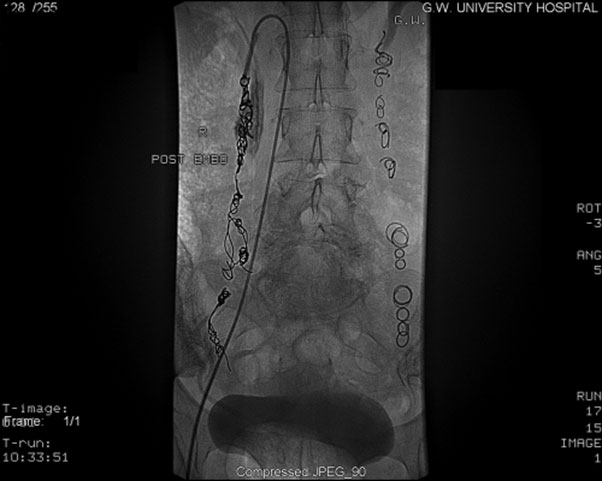
Injection of sclerosants or placing coils in the enlarged pelvic veins forces blood to redistribute through smaller channels, thus improving the symptoms of PCS.
FAQ
INTERVENTIONAL RADIOLOGY SERVICES

- Trans-arterial chemoembolization for liver tumours
- Trans-arterial radioembolization for liver tumours.
- Placement of Percutaneous gastrostomy tubes and exchanges in patients with head and neck cancer.
- Permanent tunneled drains for Malignant pleural effusions and ascites
- Pleurodesis
- Refractory pain management using image guidance
- Kyphoplasty and vertebroplasty in patients with pathological compression fractures and pain.
- Port placements and removals
- PICC lines and Hickmann lines.

- Percutaneous Transhepatic Cholangiography with biliary drain and stent placements
- Trans-jugular intrahepatic portal-systemic Shunt TIPSS
- Coil and Balloon assisted retrograde transvenous obliteration (CARTO/BRTO)
- Liver ablations
- Trans jugular liver biopsies
- Cholecystostomy
- Portal vein embolization's
- Plugged liver biopsies

- Nephrostomy
- Ureteric stents
- Removal of misplaced retrograde stents
- Suprapubic catheter placements and exchanges
- Varicocele embolization
- Renal Angiomyolipoma embolization
- Cryoablation of Renal Cell Carcinoma
- Prostate artery embolization

- Extensive experience in the management, placement and exchange of dialysis catheters.
- Optimization of AV fisulae
- Transjugular renal biopsies

- Percutaneous gastrostomy tube placement and conversion to gastro-jejunal tubes
- Embolization for bleeding
- Haemorrhoids

- Adrenal venous sampling
- Parathyroid venous sampling
- Percutanous thyroid nodule ablation

- Suction embolectomy for Pulmonary embolism
- Suction thrombectomy for DVT
- Hickmann Lines, PICC lines
- IVC Filters

- IVC filters
- Vascular stenting
- Embolization's
- Angioplasty
- Tunneled lines


- Geniculate artery embolization
- Frozen shoulder
- Plantar fasciitis

CAPE TOWN INTERVENTIONAL RADIOLOGY IS THE SWISS ARMY KNIFE OF A HOSPITAL
Client Reviews



+27 (0)83 680 3410
D18 Groote Schuur New Building, Anzio Road, Observatory, Cape Town, 7925
PRACTICE HOURS
Weekdays 8:00 – 17:00
Emergencies only after hours